Entropy, Socially Speaking
Describing how the metaphor works...

Note: This essay aims to describe - a bit more concretely - what was being pointed to - in the previous three-part essay that set up the frame.
There is a kind of tiredness that has nothing to do with overwork.
It shows up in small interactions: explaining something that shouldn’t need explanation; adding disclaimers to statements that used to stand on their own; preparing for conversations by rehearsing multiple possible framings, none of which reliably land. Nothing is obviously wrong, but nothing quite settles either.
Some societies feel like this more than others. Some airports, some cities, some bureaucracies. You know it when you’re in it, even if you lack the vocabulary.
This essay attempts to provide that vocabulary—using thermodynamics not as a model to be calculated, but as a lens for recognition.
What does it mean to say a social system is “high-entropy”? How would you know if you were in one? What does it cost? Who pays?
This is diagnostic, not prescriptive. It describes what is, how it comes about, and what it feels like to live inside it. Whether any particular state is preferable is a question each person must answer from where they stand.
Entropy is not disorder
The word “entropy” gets used loosely—as a synonym for chaos, decay, or messiness. That’s not what it means in physics, and it’s not what I mean here.
In statistical thermodynamics, entropy is a measure of how many microstates are compatible with a given macrostate. A system has high entropy when many different configurations could produce the same observable outcome. When constraints weaken, the number of possible configurations explodes.
The intuition: a shuffled deck of cards has higher entropy than a sorted one. Not because it’s “messier” in some aesthetic sense, but because there are vastly more arrangements that count as “shuffled” than arrangements that count as “sorted by suit and rank.” The sorted deck is improbable because it requires so many constraints to hold simultaneously.
Translated socially: entropy rises when the range of interpretations, responses, and outcomes compatible with “normal interaction” expands faster than shared constraints can compress it.
A low-entropy society is not one without conflict. It is one where interaction tends to terminate in predictable ways—agreement, disagreement, escalation, repair—within a stable frame.
A high-entropy society is one where interactions tend to multiply possibilities rather than collapse them. The frame itself is up for negotiation. Which rules apply here? Which version of events? Which interpretive grid?
This difference matters more than ideology, morality, or intent.
Degrees of freedom: What entropy actually means
Before scaling to societies, it’s worth being precise about what “entropy” means in this frame. Not disorder. Not chaos. Not even complexity.
Entropy is the size of the possibility space—the number of ways things could go from any given point. High entropy means many branches. Low entropy means few. The feeling of high entropy isn’t confusion about what you believe; it’s uncertainty about which reality will be invoked next.
This becomes concrete if we start at the simplest case and build up.
N=1: The uncalibrated agent
Consider a single person acting in an environment. Even before we introduce a second person, entropy can be generated.
An agent acts. The environment responds. The agent interprets that response, updates their internal model, and acts again. This loop—action, feedback, interpretation, update—is how anyone navigates reality. When it works, behavior converges: you learn what works, what doesn’t, what signals mean.
But suppose the agent is poorly calibrated. They act; something happens; they don’t read the response accurately. Maybe they miss the signal entirely. Maybe they interpret pushback as encouragement, or indifference as hostility. They update their model—but update it wrongly. Next action proceeds from a faulty map.
From the outside, this person’s trajectory becomes hard to predict. Not because the environment is chaotic—the environment might be perfectly lawful—but because the agent’s internal model has drifted from reality. Their behavior makes sense to them, following their map, but their map doesn’t match the territory.
A simple example: someone tells an inappropriate joke at a dinner party. The room goes quiet. A well-calibrated person reads the silence, recalibrates, adjusts. A poorly-calibrated person interprets the silence as “they didn’t hear me” or “they’re processing how funny it was” and doubles down. Now the room is actively uncomfortable. The person reads the discomfort as “tough crowd” and tries harder. Three iterations and they’ve generated a situation no one intended, following a logic that was internally consistent but externally illegible.
This is N=1 entropy: unpredictability generated by a single agent’s failure to compress the action-response space. The environment was providing clear signals. The agent wasn’t collapsing the possibility space; they were expanding it by misreading feedback.
Already we can see what constrains entropy at this level: accurate perception, correct attribution, functional updating. Self-awareness, essentially—the capacity to model how your actions land and adjust accordingly. When this works, the person’s behavior converges toward predictable patterns. When it fails, even a single agent’s trajectory becomes a source of uncertainty for everyone around them.
N=2: The branching tree
Now add a second person. Everything gets harder.
Each person brings to the interaction:
Intentions (which may be opaque to the other)
An interpretive frame (how they parse signals)
A response repertoire (available moves)
A model of the other (what they expect from them)
Consider the simplest possible exchange. A says something to B.
A speaks from A’s intention, using A’s frame, expecting A’s model of B to predict how it lands.
B receives this through B’s frame—which may not match A’s. B doesn’t have access to A’s intention; B only has the signal. And that signal could mean many things.
Suppose A says: “That’s an interesting approach.”
What could B hear?
Genuine appreciation — A is impressed
Polite dismissal — A thinks it’s stupid but is being civil
Veiled criticism — “Interesting” is code for “wrong”
Request for elaboration — A wants to understand more
Power move — A is positioning as evaluator, B as evaluated
Five interpretations, each plausible, each opening different response sets.
If B hears (1), B might elaborate confidently, share more. If B hears (2), B might get defensive, push back, or disengage. If B hears (3), B might defend the approach or attack A’s standing to judge. If B hears (4), B might explain further. If B hears (5), B might accept the frame, or challenge it, or deflect.
That’s five interpretations, each with (let’s say) five possible responses. One utterance from A, and we already have 25 possible next-states from B’s side alone.
Now B responds. Say B chooses to elaborate confidently (having interpreted genuine appreciation). A receives this response.
But A might interpret B’s elaboration as:
Confirmation — B understood, good
Overconfidence — B is missing the subtle criticism
Showing off — B is performing rather than engaging
Genuine enthusiasm — B is excited about the work
Testing — B is probing whether A really understood
Another five branches. A responds to their interpretation—which may not match B’s intent. B receives that response through B’s frame...
Two exchanges in, we’re at potentially 25 × 25 = 625 trajectories, most of which A and B aren’t even aware they didn’t take. Each is tracking a single path—their own experience—while the other is potentially on a different branch entirely.
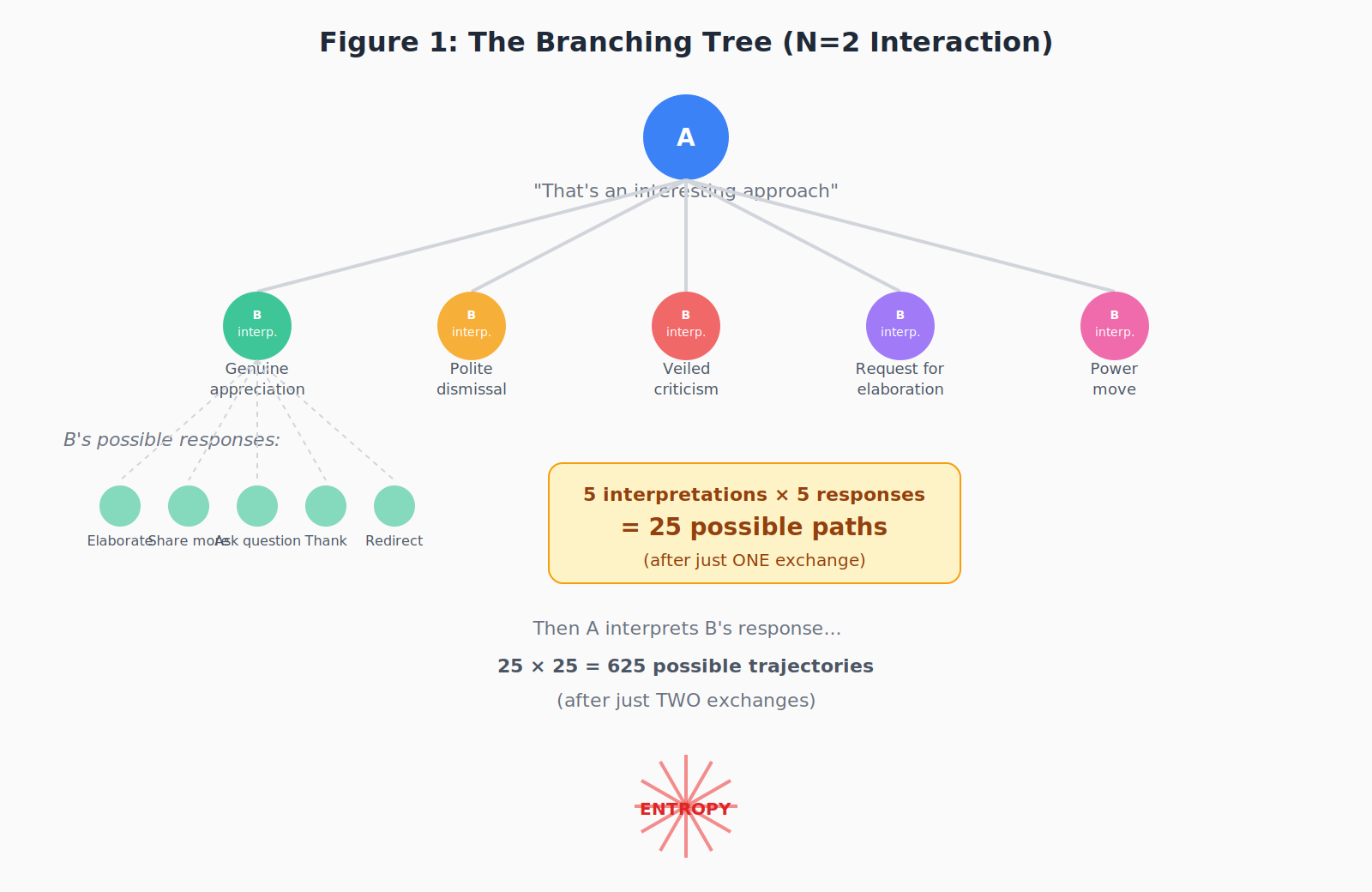
This is what social entropy is: not confusion at any single moment, but the multiplication of possible paths. The space of “where could this go next?” expanding faster than either party can track.
What collapses the tree
The remarkable thing about most human interaction is that it doesn’t feel like this. We don’t experience every conversation as 625 forking paths.
That’s because the tree is usually pruned before we enter it.
Shared scripts: If A and B both know they’re in a buyer-seller interaction, most branches never exist. “That’s an interesting approach” doesn’t have five readings; it has one, or maybe two. The script tells you what utterances mean in this context.
Legible signals: If A’s tone, facial expression, and context all point the same way, the ambiguity collapses. Genuine appreciation looks different from polite dismissal. When signals are legible, interpretation converges.
Shared context: We agree on what situation we’re in. A job interview, a first date, a sales pitch, a collaboration. The context constrains what moves are available and what they mean.
Bounded repertoires: Neither party has infinite responses. Culture, personality, relationship history all constrain the action space. I know you well enough to know you won’t respond with options 3, 4, or 5—you’re a “1 or 2” person.
Enforcement backdrop: Some branches are pruned by consequences. If I misinterpret badly, I’ll face correction. If I deviate from script, there are costs—reputational, relational, material. The threat of sanction keeps behavior in the predictable channel.
Repeated interaction: We’ve played this game before. We’ve calibrated to each other. I know how you use “interesting.” You know how I respond to criticism. Our personal history has already collapsed most of the ambiguity.
When these mechanisms are strong, the 625-path tree collapses to 2 or 3 paths. The interaction feels almost mechanical. “We both know how this goes.” That’s low entropy: the possibility space is small.
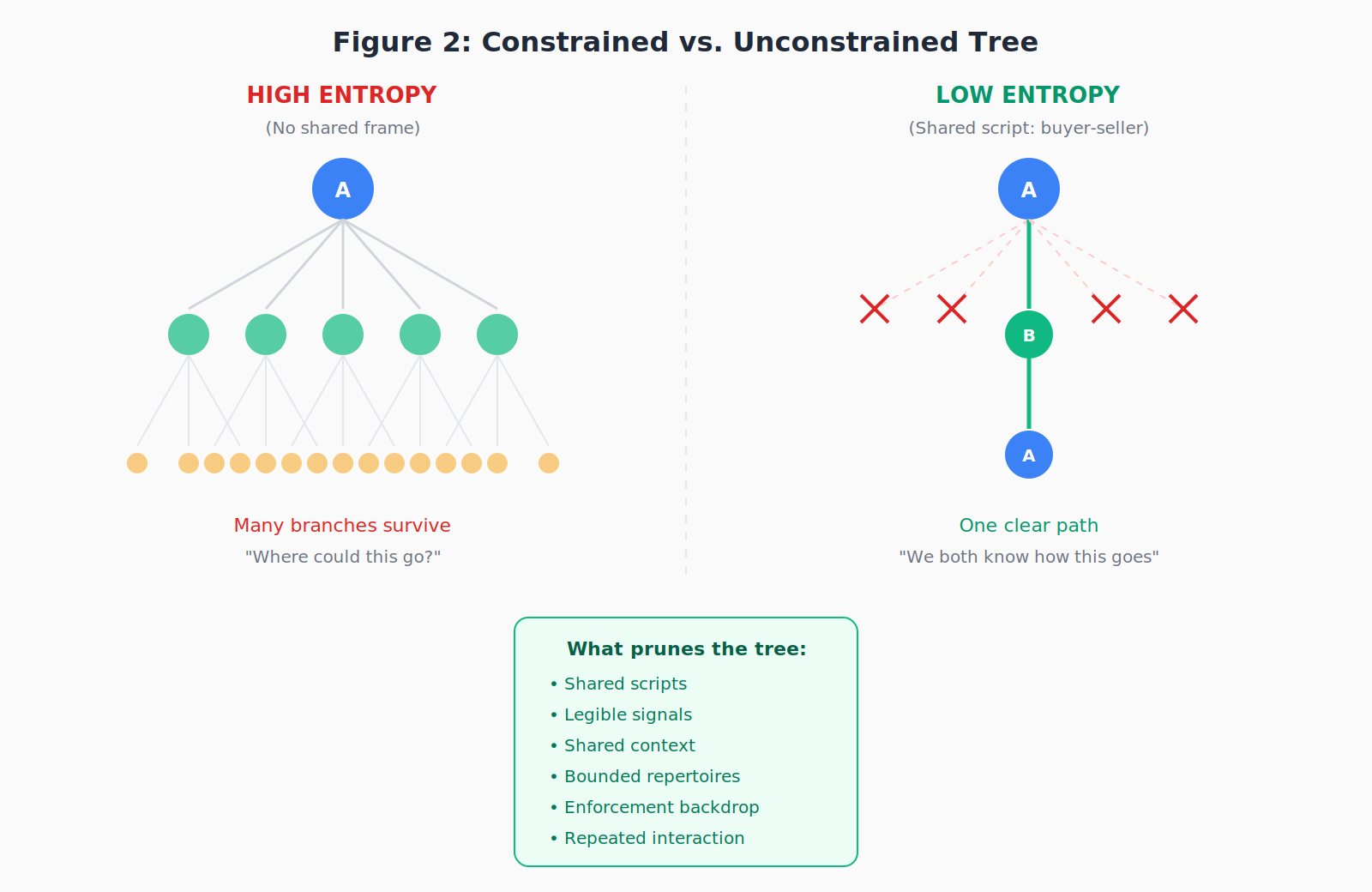
When these mechanisms fail—contested scripts, opaque signals, heterogeneous frames, one-shot encounters, weak enforcement—the tree stays bushy. Every exchange point reopens the branching structure. That’s high entropy: the possibility space is large, and keeps expanding.
Scaling up: Compression at each level
The same structure repeats at every scale, but the compression mechanisms change form.
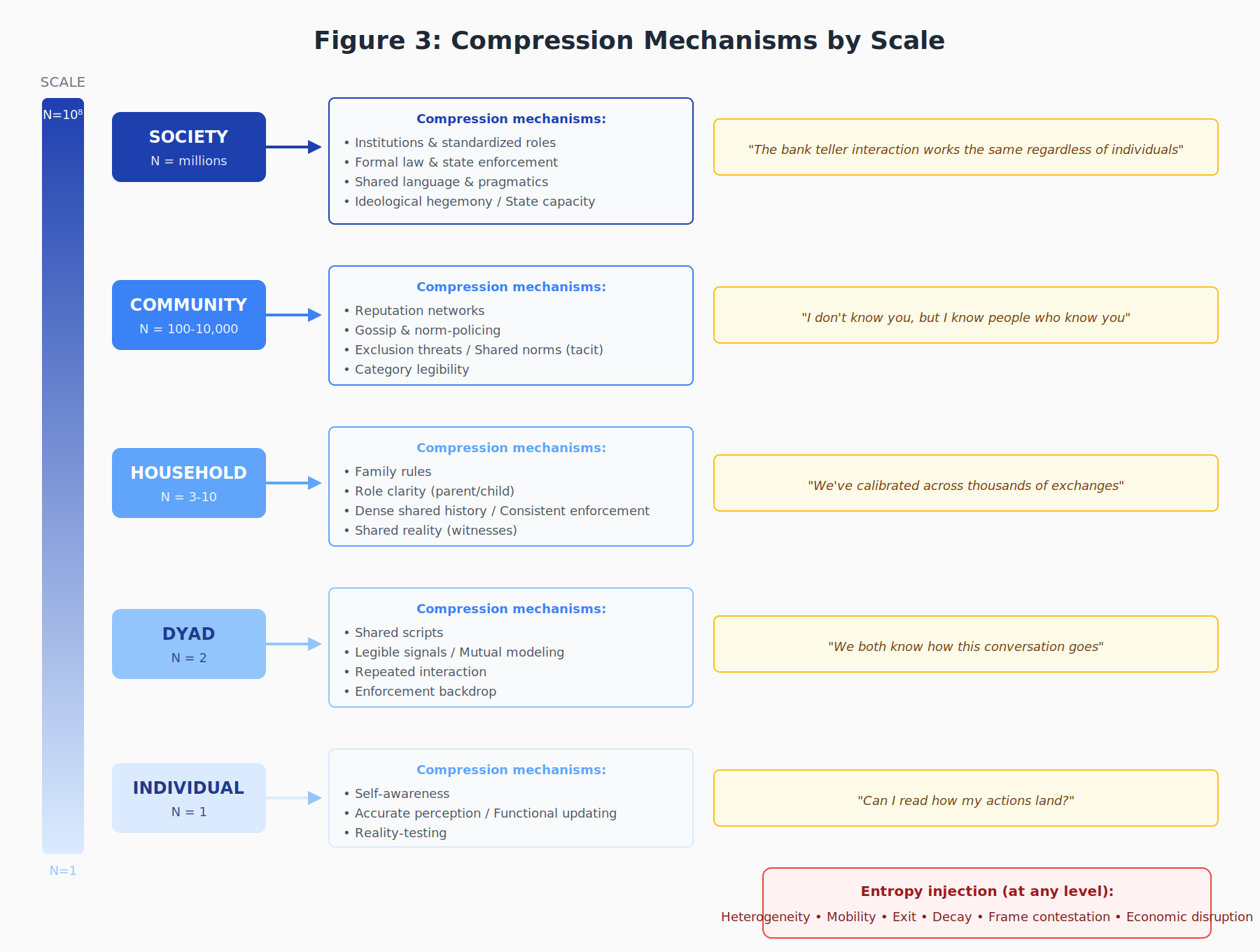
Household (N = 3-10)
The family is a machine for collapsing degrees of freedom among intimates.
Family rules: Not laws, but understood patterns. “We don’t raise voices.” “Homework before screens.” “Mom decides X, Dad decides Y.” Rules constrain the action space.
Role clarity: Parent, child, elder, guest. Each role comes with scripts. Deviation is visible against the baseline.
Shared history: Dense repeated interaction. We’ve already calibrated to each other across thousands of exchanges. Ambiguity has been resolved through friction over time.
Consistent enforcement: The same behavior gets the same response. Unpredictability in enforcement (sometimes punished, sometimes ignored) increases entropy by making consequences uncertain.
Shared reality: We were all there. We know what happened. Divergent narratives are harder to sustain when witnesses are permanent.
The household absorbs entropy that would otherwise make daily life impossible. This is thermodynamic work: creating a low-entropy zone against the gradient of external unpredictability. When the household functions, members can relax internal vigilance. They know how things go here.
When household compression fails—inconsistent rules, contested narratives, roles in flux, enforcement that varies by mood—the home becomes as unpredictable as the street. There’s no zone of rest.
Community (N = 100-10,000)
Beyond the household, you can’t rely on personal calibration. There are too many people; you can’t have dense repeated interaction with all of them. Different compression mechanisms kick in.
Reputation: I don’t know you, but I know people who know you. Information travels. Your history constrains my expectations of your behavior. You know your actions will be reported. This prunes branches you might otherwise take.
Gossip: The enforcement mechanism of reputation. Not just information-sharing but active norm-policing. Communities where gossip flows freely are tightly constrained; communities where it doesn’t (anonymous urban neighborhoods, online spaces) have higher entropy.
Exclusion threats: The ultimate sanction at community scale. You can’t imprison, but you can ostracize. The threat keeps behavior within bounds.
Shared norms: Not formal law, but “how things are done here.” Often tacit, learned through observation and correction. The newcomer is high-entropy until they absorb the norms; then they become predictable.
Category legibility: I know what kind of person you are—your caste, your profession, your family, your neighborhood. Categories come with scripts. I interact with the category, not the unknowable individual. This is compression: reducing a complex person to a tractable role.
This explains why communities resist heterogeneity. Not necessarily from malice—from thermodynamics. Every person who doesn’t fit existing categories, doesn’t share existing scripts, increases degrees of freedom. The community must either absorb them (socialization, which takes time and energy) or wall them off (enclaves) or tolerate higher entropy (more unpredictable interactions).
Society (N = millions)
At national scale, you can’t rely on reputation, gossip, or direct exclusion. The compression mechanisms become abstract.
Institutions: Standardized roles with standardized scripts. I don’t interact with you personally; I interact with “bank teller,” “police officer,” “shopkeeper.” The role predicts behavior well enough that I don’t need to model the individual.
Formal law: Explicit rules, formally enforced, applicable regardless of relationship. Replaces the implicit enforcement of community norms.
Shared language: Not just vocabulary but pragmatics—what signals mean, how disagreement is expressed, what counts as an answer. Linguistic homogeneity is entropy-reducing.
Shared ideology: Agreement on basic interpretive frames. What counts as legitimate authority, what values matter, how conflict is resolved. Ideological homogeneity means we’re at least working from the same frame.
State capacity: The ability to actually enforce the formal rules. Written law without enforcement is just text; enforcement without consistency is noise. Effective states compress behavior by making the consequences of deviation predictable.
Low-entropy societies achieve a kind of social anonymity: strangers are interchangeable. The convenience store transaction in Tokyo works the same regardless of which clerk and which customer. You don’t need to assess the individual; the role compression is that complete.
High-entropy societies require constant assessment. Which version of this interaction will we be having? Does this person follow the formal rules or the informal ones? Which script applies here? The interaction begins with frame-negotiation, which is itself a source of entropy.
Entropy injection: What disrupts compression
Once we see what maintains low entropy at each level, we can identify what disrupts it. Think of these as “heat sources”—energy inputs that increase kinetic randomness and disrupt settled patterns.
Heterogeneity: New members who don’t share the scripts. Immigration, urbanization, any influx faster than socialization can absorb. Each unassimilated newcomer adds degrees of freedom.
Mobility: People moving between systems, carrying incompatible frames. The person who grew up here but went away and came back different. The transplant who keeps asking “but why do you do it that way?”
Communication exposure: Discovery that others do it differently. Television, internet, travel—anything that shows alternative frames exist. “Wait, other families don’t have that rule?” Suddenly the rule is no longer given; it’s a choice. Choices can be contested.
Economic change: Old scripts become non-functional, new situations lack scripts. The artisan whose craft is automated. The village where agriculture no longer works. Economic disruption destroys the material base of existing compressions without providing new ones.
Individual exit: Someone opts out of the shared frame, demonstrating it’s not universal. The child who refuses the family role. The community member who leaves for the city. Each exit reveals the frame as contingent rather than natural.
Institutional decay: Enforcement becomes patchy; rules apply to some but not others. Inconsistency is poison for compression. If the same behavior sometimes has consequences and sometimes doesn’t, the behavior is no longer constrained.
Frame contestation: Active challenge to the dominant interpretive frame. Political movements, cultural shifts, generational change. Not just different scripts but disagreement about which script is legitimate.
These forces are always operating. Low-entropy states require continuous maintenance—energy expenditure to keep the compression mechanisms functioning. When the maintenance stops, or becomes too costly, or is overwhelmed by entropy injection, the system drifts toward higher entropy.
The drift is usually gradual. Not a sudden collapse but a slow erosion: more interpretations becoming possible, more responses becoming thinkable, more frame-negotiation required. The change is imperceptible until, looking back, you realize you’re in a different system than you were.
The central claim
This is what the thermodynamic metaphor offers: a way to see degrees of freedom as the fundamental quantity.
Every interaction has a possibility space—the set of trajectories it could take. Low entropy means that space is small: things go how they go. High entropy means the space is large: things could go many ways, and you don’t know which way until you’re in it.
Compression mechanisms—scripts, roles, norms, enforcement, shared frames—are what collapse possibility space into predictable paths. They’re not constraints on freedom in the libertarian sense; they’re constraints on uncertainty. They let you know what happens next.
The work of social order is the work of maintaining compression: socializing new members, enforcing norms, repairing violations, updating scripts when old ones fail. When that work isn’t done, the tree stays bushy. Every interaction becomes freshly branching. That’s exhausting—not because any single interaction is hard, but because none of them are automatic.
Societies, communities, households, dyads—they all face the same problem at different scales: how to keep the possibility space small enough that coordination is feasible. The mechanisms differ, but the structure is the same.
How to recognize it: The phenomenology
High-entropy systems aren’t necessarily violent or visibly unstable. Often they’re prosperous, articulate, well-intentioned. What distinguishes them is the cost of coordination.
You see it in:
Time costs of simple transactions. Not queue length, but process friction. How long does it take to do something that “should” be simple?
Intermediary density. How many fixers, agents, brokers exist to navigate gaps between you and institutions? Specialists who know how to translate between frames.
The documentation gap. The distance between what’s written (law, policy, procedure) and what actually happens. Not corruption exactly—more like parallel operating systems.
Tolerance for visible inconsistency. Can two contradictory things operate side by side without anyone feeling obligated to resolve them?
Physical layering. Built environment that shows accumulation without integration. Wires. Signage. Construction that assumes other construction rather than replacing it.
Multiplicity of access regimes. Does the same service have different prices, processes, entry points depending on who you are, who you know, which route you take?
The dominant affect is not fear, but vigilance. Not confusion, but exhaustion. People aren’t unsure what they believe. They’re unsure which version of reality will be invoked next.
Certain spaces are diagnostic. Airports, bureaucracies, public hospitals—anywhere large numbers of strangers must coordinate briefly and move on. Some feel legible even when inefficient. Others feel negotiable even when rule-bound. Heathrow feels different from Schiphol. Bangalore feels different from Singapore. The difference is entropy.
Paradigm cases
Japan is perhaps the clearest low-entropy example. Strangers behave predictably. Not because they’re conformist by nature, but because scripts are so deeply shared that you know what happens next. The convenience store transaction, the quiet train car, the walking side of the escalator. These aren’t laws; they’re shared compressions of behavior.
Deviation is visible against a clear baseline. Time spent on process is minimal because process is predictable. You can allocate attention elsewhere.
India offers a high-entropy counterpoint. Within communities—caste, family, religious group—compression can be tight. Internal scripts are known; deviation is sanctioned. But between groups, the degrees of freedom explode. No hegemonic frame governs cross-group interaction. Modern urban life forces constant cross-group contact.
What outsiders sometimes celebrate as “tolerance” or “and/and thinking” is often the cultural technology for navigating high-entropy interactions without insisting on resolution. You don’t try to align frames; you accommodate the mismatch and move on. The cost: nothing stabilizes. Every interaction is freshly negotiated.
Lebanon makes the pattern visible politically. Eighteen recognized confessional groups, a political system built on sectarian allocation, no hegemonic frame. Every significant interaction potentially involves navigating which set of rules applies. Beirut physically shows this—neighborhoods with different logics, different aesthetic regimes, different enforcement. They don’t integrate; they abut.
Transitions: How systems change state
Low to high
Yugoslavia is vivid. Tito’s project was active entropy suppression—pan-Yugoslav identity promoted, ethnic expression managed, the formula of “brotherhood and unity.” Partly ideological, partly charismatic, partly coercive.
When the compression mechanism failed (Tito’s death, economic crisis, ideological collapse), the suppressed heterogeneity didn’t just re-emerge; it exploded. The degrees of freedom had been there all along, held down. Once released, the system didn’t find new equilibrium; it fragmented violently.
The transition was experienced as: suddenly you couldn’t predict your neighbor. Someone you’d lived beside for decades was now operating in a different frame. The shared scripts dissolved.
The USSR showed similar structure. One ideology, one language of public life, active homogenization. When it collapsed, constituent parts didn’t just separate administratively; suppressed heterogeneities re-emerged. Central Asian clan structures, Caucasus ethnic conflicts, Baltic nationalisms—all had been there, compressed.
High to low
France’s republican project is the classic case. Pre-revolutionary France was high-entropy: multiple languages, multiple legal regimes, regional identities primary. The revolutionary and post-revolutionary project was deliberate entropy reduction. One language (Parisian French, enforced through schools), one legal code, one citizenship, aggressive suppression of regional identities.
The project took generations but it worked. France became legible, compressed. The cost: what was suppressed. The method: state coercion, institutional capture, ideological hegemony.
Turkey under Atatürk followed similar logic. The Ottoman millet system was managed high-entropy. Kemalist Turkey was forced compression: one language, one script, one identity, secularism as compression of religious heterogeneity.
The pattern suggests: low-to-high transitions happen through compression failure, often catastrophically. High-to-low transitions require coercive state capacity, ideological project, and time—usually generations. Peaceful high-to-low transition is rare.
What keeps high-entropy systems running?
In thermodynamics, a system at true equilibrium doesn’t need energy input. But high-entropy societies that persist aren’t at equilibrium; they’re dissipative structures—maintained far from equilibrium by continuous throughput.
Economic throughput is the obvious energy source. Money lubricates. It allows negotiation, greases workarounds, funds intermediaries. When you pay the fixer, pay the premium for the informal service, you’re supplying energy that keeps the system liquid. Without economic flow, the system would seize up.
This may explain why economic crises are existential for high-entropy societies in ways they aren’t for low-entropy ones. Japan can have a lost decade and remain Japan—the compression holds without economic lubrication. India without growth is a different proposition.
Household labor is the hidden energy source. The household absorbs shocks, creates local order, buffers members from external chaos. This is thermodynamic work: creating low-entropy zones against the gradient of external high-entropy. The women managing households are doing integration work the state doesn’t do.
Political contestation paradoxically helps. Elections, protests, the churn of democratic politics—these channel energy that might otherwise find destructive expression. The periods when this channel is blocked may be more dangerous than the chaos of open contestation.
Local equilibria: What informality actually is
One way high-entropy systems persist is by allowing local equilibria to form without enforcing global coherence.
This looks like informality.
The informal settlement isn’t chaos; it’s local order without formal integration. Within Dharavi, there are understood rules, reputations, enforcement mechanisms. The leather market knows who’s reliable, what the prices are. That’s a local equilibrium—low-entropy within its domain.
But the interface between informal and formal is high-entropy. Crossing from one to the other requires negotiation, intermediaries, workarounds.
Caste panchayats, religious community governance, ethnic business networks—all local equilibria. They do real governance work: dispute resolution, norm enforcement, resource allocation. They’re effective within their domain. But they don’t interface with each other or with the formal state.
India might be characterized as: multiple local equilibria with high-entropy interfaces between them. Within your community, things are predictable. Between communities, nothing is automatic.
The state’s role becomes: managing interfaces without trying to integrate them. Keeping high-entropy zones from becoming violent. Providing just enough overarching frame—law, currency, infrastructure—that local equilibria can coexist. But not attempting French-style integration, because that would require energy the system can’t supply.
Who pays
Entropy costs are not evenly distributed.
Those who bear the highest costs are typically those stuck at interfaces: the migrant who belongs to no local equilibrium; the person whose category is ambiguous; anyone who must navigate between frames without belonging fully to any.
Household labor—overwhelmingly female—absorbs entropy that would otherwise make daily life impossible. The “and/and thinking” celebrated in accounts of Indian civilization is often performed by women reconciling contradictions that men don’t have to notice.
Intermediaries profit from entropy but also bear its weight. The fixer, the broker, the translator between frames—their existence signals system friction. Their work is real but invisible in formal accounts.
Low-status individuals bear entropy costs that high-status individuals can purchase their way out of. The rich person’s interaction with bureaucracy is mediated, smoothed, compressed by money and connection. The poor person experiences the full friction.
Why metaphor, not model
Previous attempts to apply thermodynamics to society—Kenneth Bailey’s Social Entropy Theory, applications of Prigogine’s dissipative structures, sociophysics—mostly stalled. Why?
They tried to make it rigorous. They borrowed Shannon entropy or statistical mechanics and attempted formal mapping. But the mapping problem is insurmountable: What exactly corresponds to temperature? Energy? Microstates? Physical concepts have precise definitions that don’t translate cleanly.
More fundamentally: people aren’t particles. Particles don’t have intentions, don’t interpret situations, don’t change behavior when they learn about patterns. Statistical mechanics works because particles don’t know they’re in a statistical ensemble. Social actors know, and adjust.
Metaphor works differently. It says: this is like that. It creates resonance, recognition, a felt sense of similarity without requiring that the similarity be precisely formalizable.
The thermodynamic metaphor for social systems:
Offers vocabulary (degrees of freedom, compression, equilibrium, dissipation)
Orients attention (look for compression mechanisms, energy inputs, who does integration work)
Enables comparison (this society feels like that one, this transition resembles that one)
Preserves ambiguity where the phenomenon is genuinely fuzzy
Metaphor can accommodate psychological variability because it doesn’t require commensuration. “This interaction has high degrees of freedom” doesn’t require measurement. It requires recognition—the feeling of not knowing where this is going, of scripts not holding.
For genuinely fuzzy phenomena, evocative description may be more accurate than false precision. The model that draws sharp lines is wrong because the phenomenon doesn’t have sharp lines. The description that preserves fuzziness is right because the fuzziness is real.
No prescriptions, only trade-offs
This framework doesn’t tell you what to choose.
Low entropy constrains. It requires that someone’s frame become dominant, others suppressed. The efficiency is purchased with erasure.
High entropy exhausts. It externalizes integration work to individuals. The pluralism is purchased with friction.
Informality stabilizes locally while sacrificing universality. Formality scales while amplifying coordination costs.
There is no frictionless state. Only different ways of paying.
What the framework offers is not solutions but recognition: the ability to see what kind of system you’re in, what kinds of energy it consumes, what kinds of failures it tends toward.
One might reframe “good” as: what persists. What survives across time, absorbs shocks, heals fractures. By that measure, high-entropy systems have something going for them. They’re closer to thermodynamic “naturalness”—they don’t require continuous suppression to maintain. When low-entropy systems lose their compression mechanism, they don’t gracefully degrade; they shatter. High-entropy systems are already accommodating heterogeneity; they bend rather than break.
But persistence isn’t comfort. Surviving isn’t thriving. The person stuck at high-entropy interfaces, doing integration work without recognition, may reasonably prefer a different arrangement—even one that comes with its own costs.
In complex, non-equilibrium social systems, prediction is weak, intervention is risky, and learning is often retrospective. Wisdom lies less in designing outcomes than in understanding what each state transition implies for lived experience—and preparing for consequences when it fails.
That may be unsatisfying.
It is, however, honest.